What is Quantum Computing Explained: The Future of Computation
Explore the mind-bending principles of quantum mechanics that promise to redefine problem-solving and technological advancement.
Start Your Quantum JourneyKey Takeaways
- ✓ Quantum computers use qubits instead of bits, allowing for superposition and entanglement.
- ✓ They can solve certain complex problems exponentially faster than classical computers.
- ✓ Quantum mechanics, such as superposition and entanglement, are the core principles.
- ✓ The technology is still in its early stages but holds immense potential for various fields.
How It Works
Unlike classical bits (0 or 1), qubits can be 0, 1, or both simultaneously (superposition). This expanded state space dramatically increases processing potential.
Superposition allows a qubit to exist in multiple states at once. This means a quantum computer can explore many possible solutions concurrently, rather than sequentially.
Entanglement is a phenomenon where two or more qubits become linked, sharing the same fate regardless of distance. This interconnectedness enables complex computations and correlations.
Quantum algorithms manipulate these entangled and superposed states. Interference is then used to amplify correct answers and cancel out incorrect ones, guiding the system to the optimal solution.
The Fundamental Difference: Qubits vs. Bits
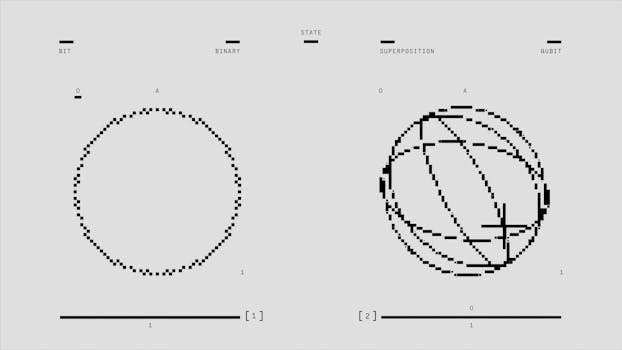 Photo: Google DeepMind / Pexels
Unlocking Power: Superposition and Entanglement
 Photo: photoGraph / Pexels
The Promise of Quantum Algorithms and Real-World Applications
 Photo: Myburgh Roux / Pexels
Challenges and the Road Ahead for Quantum Computing
 Photo: Ramaz Bluashvili / Pexels
Comparison
| Feature | Quantum Computer | Classical Computer | Human Brain |
|---|---|---|---|
| Basic Unit | Qubit | Bit | Neuron |
| Information States | 0, 1, or both (superposition) | 0 or 1 | Complex electrochemical states |
| Processing Method | Parallel (superposition & entanglement) | Sequential | Highly parallel (neural networks) |
| Error Rate | High (requires error correction) | Low | Subject to biological errors |
| Best For | Specific complex problems (optimization, simulation, cryptography) | General-purpose computing, data storage, everyday tasks | Pattern recognition, creativity, learning, intuition |
| Energy Efficiency | Potentially high for specific tasks | Relatively high for general tasks | Extremely high for its capabilities |
| Current Availability | Limited access (cloud, research labs) | Widespread | N/A |
What Readers Say
"This article on what is quantum computing explained demystifies complex concepts brilliantly. It's an essential read for anyone looking to understand the core principles without getting lost in jargon."
Dr. Anya Sharma · Cambridge, MA"As a software engineer, I found the breakdown of qubits, superposition, and entanglement incredibly clear. It truly helped me grasp the foundational differences from classical computing."
Mark Jenkins · San Francisco, CA"The sections on quantum algorithms and real-world applications provided a clear vision of the future. I now feel much better equipped to discuss the potential impact of this technology in my industry."
Sarah Chen · Austin, TX"The explanation of challenges like decoherence was very insightful, though I wish there was a bit more detail on specific quantum programming languages. Overall, a highly informative overview."
David Miller · Seattle, WA"From a business perspective, understanding what is quantum computing explained is crucial. This article laid out the opportunities and current limitations perfectly, aiding in strategic planning."
Emily Rodriguez · New York, NYFrequently Asked Questions
What is the main difference between classical and quantum computing?
The main difference lies in their fundamental units: classical computers use bits (0 or 1), while quantum computers use qubits, which can be 0, 1, or both simultaneously (superposition). This allows quantum computers to process information in fundamentally different and potentially more powerful ways for certain problems.
Is quantum computing going to replace classical computing entirely?
No, it's highly unlikely that quantum computing will replace classical computing entirely. Quantum computers are specialized tools designed to solve specific, highly complex problems that are intractable for classical machines. Classical computers will continue to be essential for everyday tasks, general applications, and many scientific computations.
How do quantum computers work at a fundamental level?
Quantum computers work by harnessing principles of quantum mechanics: superposition, which allows qubits to exist in multiple states at once; and entanglement, which links qubits so their states are correlated. Quantum algorithms then manipulate these states, using interference to amplify correct solutions and cancel incorrect ones.
How expensive is quantum computing, and is it accessible to individuals?
Quantum computing hardware is currently extremely expensive to build and maintain, often requiring specialized environments like ultra-cold refrigerators. It is not accessible to individuals in the consumer market. However, many quantum computing platforms are available via cloud services, allowing researchers and developers to experiment with quantum processors remotely.
How does quantum computing compare to artificial intelligence?
Quantum computing is a new paradigm of computation, while artificial intelligence is a field of computer science focused on creating intelligent machines. Quantum computers can potentially accelerate AI by providing faster processing for complex machine learning algorithms, allowing AI systems to analyze larger datasets and learn more efficiently. They are complementary technologies.
Who should be learning about quantum computing now?
Researchers in fields like materials science, drug discovery, finance, and logistics should be learning about quantum computing to understand its potential impact on their industries. Computer scientists, physicists, and mathematicians interested in cutting-edge computation and algorithm design will also find it highly relevant. Early adopters in tech can gain a significant advantage.
Are there any risks associated with the development of quantum computing?
Yes, one significant risk is its potential to break current cryptographic standards, which secure much of our digital communication and financial transactions. This has led to research into 'post-quantum cryptography.' Other concerns include the ethical implications of its power and the potential for misuse, similar to any powerful new technology.
What major breakthroughs can we expect from quantum computing in the next decade?
In the next decade, we can expect significant progress in building more stable and error-corrected qubits, leading to 'noisy intermediate-scale quantum' (NISQ) devices that can perform calculations beyond classical capabilities for specific niche problems. We'll likely see breakthroughs in quantum chemistry simulations, materials design, and optimization for logistics and finance, moving closer to practical applications.
Embark on your journey into the future of technology by understanding what is quantum computing explained. This revolutionary field promises to redefine problem-solving, offering unparalleled opportunities for innovation across every sector. Stay informed and be part of the quantum revolution.