
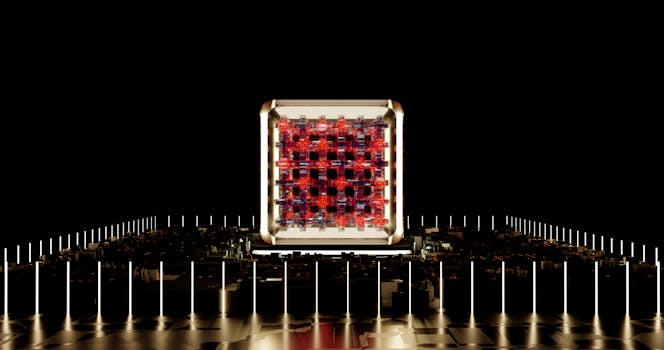
 Photo: Pachon in Motion / Pexels
What is Quantum Computing Basics? Unlock the Future
Explore the foundational concepts of quantum computing and its revolutionary implications for technology and science.
Start Learning NowKey Takeaways
- ✓ Quantum computing uses quantum-mechanical phenomena like superposition and entanglement.
- ✓ Unlike classical bits, qubits can represent 0, 1, or both simultaneously.
- ✓ It promises to solve problems intractable for even the most powerful classical supercomputers.
- ✓ Major applications include drug discovery, materials science, and cryptography.
How It Works
Classical computers use bits (0 or 1). Quantum computers use qubits, which leverage superposition to exist in multiple states at once.
Superposition allows a qubit to be a combination of 0 and 1 simultaneously, dramatically increasing the information density compared to classical bits.
Entangled qubits are linked such that the state of one instantly influences the state of another, no matter the distance, forming powerful computational networks.
Quantum gates are the building blocks of quantum circuits, manipulating qubit states to perform operations, analogous to logic gates in classical computing.
The Fundamental Shift: From Bits to Qubits and Beyond
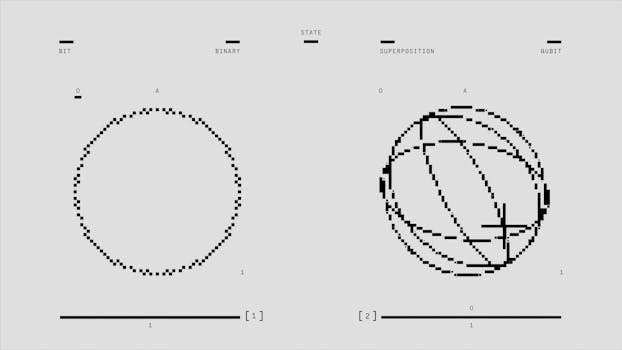 Photo: Google DeepMind / Pexels
Enter the quantum realm, where the rules of physics are profoundly different and far more intriguing. The core innovation of quantum computing lies in its use of 'qubits' – quantum bits. Unlike a classical bit, a qubit doesn't have to be just a 0 or a 1. Thanks to a quantum mechanical phenomenon called 'superposition,' a qubit can exist as a 0, a 1, or a combination of both simultaneously. Imagine flipping a coin: a classical bit is either heads or tails. A quantum coin, while spinning in the air, is both heads and tails at the same time until it lands. This ability to be in multiple states at once means that a single qubit can hold far more information than a classical bit. As you add more qubits, the informational capacity grows exponentially. For example, two qubits can exist in four states simultaneously (00, 01, 10, 11), three qubits in eight states, and so on. This exponential scaling is what gives quantum computers their potential power.
Beyond superposition, another mind-bending quantum phenomenon crucial to quantum computing is 'entanglement.' When qubits become entangled, their fates are inextricably linked, no matter how far apart they are. If you measure the state of one entangled qubit, you instantly know the state of the other, even if they are light-years apart. This 'spooky action at a distance,' as Einstein famously called it, allows quantum computers to perform operations on multiple qubits simultaneously, enabling complex calculations in parallel. It's like having a network of interconnected processing units that can instantaneously share information and influence each other's states.
These two principles – superposition and entanglement – are the bedrock upon which quantum algorithms are built. They allow quantum computers to explore multiple computational paths simultaneously, drastically reducing the time needed to solve certain types of problems. While classical computers must test each possibility sequentially, quantum computers can, in essence, test them all at once. This isn't to say quantum computers will replace classical ones for everyday tasks; they are specialized tools designed for specific, highly complex problems that are currently intractable. Understanding these foundational concepts is the first crucial step in appreciating the revolutionary potential of quantum technology and how it will reshape our future. For more on the foundational science, explore quantum mechanics principles.
Architectures and the Quest for Stable Qubits
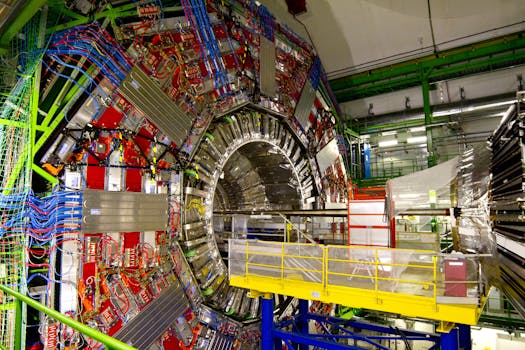 Photo: Ramaz Bluashvili / Pexels
One of the most prominent architectures involves 'superconducting qubits.' These are tiny electrical circuits made from superconducting materials, typically cooled to temperatures colder than deep space (millikelvin temperatures) to eliminate electrical resistance and thermal noise. At these ultra-low temperatures, electrons can move without resistance, allowing for the manipulation of their quantum states. Companies like IBM and Google have made significant strides with superconducting qubits, building processors with increasing numbers of these delicate components. The challenge here is scaling up while maintaining coherence for longer periods.
Another promising approach uses 'trapped ions.' In this method, individual atoms are stripped of an electron to become ions, then suspended in a vacuum using electromagnetic fields. Lasers are then used to manipulate the internal quantum states of these ions, which act as qubits. Trapped ions boast excellent coherence times and high-fidelity operations, meaning fewer errors. Companies like IonQ are at the forefront of this technology. The hurdle for trapped ion systems is the difficulty in scaling them to a very large number of qubits while maintaining the precision of laser control for each ion.
Other architectures include 'topological qubits,' which aim to encode information in the topological properties of matter, making them inherently more robust against decoherence. While still largely theoretical and experimental, Microsoft is a major proponent of this approach, believing it could lead to more stable and error-resistant quantum computers. 'Photonic qubits' use individual photons (particles of light) as qubits, leveraging optical components to manipulate their quantum states. This approach has the advantage of operating at room temperature and being less susceptible to some forms of environmental noise, but generating and controlling single photons efficiently remains a challenge.
Each of these architectures has its own strengths and weaknesses, and the race is on to develop a robust, scalable, and error-corrected quantum computer. The choice of architecture impacts everything from the size and cost of the quantum computer to the types of errors it might encounter and the methods used for error correction. Researchers are also exploring 'neutral atoms,' 'silicon spin qubits,' and even 'diamond vacancies' as potential qubit platforms. The diversity of approaches underscores the complexity and the pioneering nature of this field, as scientists and engineers worldwide work to overcome the daunting technical hurdles to build a practical quantum computer. The journey from a few entangled qubits to a fault-tolerant quantum computer is long and arduous, but the potential rewards are immense, driving relentless innovation in quantum hardware.
Quantum Algorithms and Their Transformative Potential
One of the most famous quantum algorithms is Shor's Algorithm. Developed by Peter Shor in 1994, this algorithm can efficiently factor large numbers into their prime components. While this might sound academic, it has profound implications for cybersecurity. Many modern encryption methods, such as RSA, rely on the computational difficulty of factoring large numbers. A sufficiently powerful quantum computer running Shor's Algorithm could break these encryption schemes, potentially compromising vast amounts of sensitive data. This has spurred significant research into 'post-quantum cryptography' – new encryption methods designed to be resistant even to quantum attacks.
Another pivotal algorithm is Grover's Algorithm, which provides a quadratic speedup for searching unsorted databases. For a classical computer, finding a specific item in an unsorted list of N items takes, on average, N/2 steps. Grover's Algorithm can do it in approximately the square root of N steps. While this isn't an exponential speedup like Shor's, it's still a significant improvement for many applications, from optimizing search queries to database management.
Beyond these foundational algorithms, quantum computing holds immense promise for scientific research and industrial applications. In materials science and chemistry, quantum computers can simulate molecular interactions with unprecedented accuracy. This ability is critical for drug discovery, allowing researchers to design and test new molecules for pharmaceuticals much faster and more efficiently. It could also lead to the development of novel materials with extraordinary properties, such as superconductors that work at room temperature, more efficient catalysts, or lighter, stronger alloys.
Optimization problems are another sweet spot for quantum algorithms. Industries ranging from finance to logistics are constantly seeking to optimize complex systems – think of optimizing investment portfolios, designing efficient delivery routes, or managing complex manufacturing schedules. Quantum optimization algorithms, like the Quantum Approximate Optimization Algorithm (QAOA), could find optimal solutions to these problems far more effectively than classical methods, leading to significant cost savings and increased efficiency.
Machine learning is also poised for a quantum revolution. 'Quantum machine learning' algorithms aim to leverage quantum principles to process vast datasets more efficiently, potentially leading to more powerful AI. This could impact everything from image recognition and natural language processing to developing more sophisticated autonomous systems.
It's important to note that many of these applications are still in their early stages of development. While quantum computers are not yet ready to tackle all these problems at scale, the theoretical frameworks and initial demonstrations show immense potential. The ongoing research into new quantum algorithms and the continuous improvement of quantum hardware are paving the way for a future where these transformative applications become a reality. To learn more about how these algorithms are implemented, delve into quantum circuit design.
Challenges and the Road Ahead for Quantum Computing
One of the foremost challenges is 'decoherence.' As mentioned, qubits are incredibly sensitive to their environment. Any interaction with the outside world – even minute vibrations or temperature fluctuations – can cause them to lose their fragile quantum state, leading to errors. Maintaining coherence for long enough to perform complex calculations requires extreme isolation, often involving ultra-low temperatures and vacuum environments, which are technically demanding and expensive to maintain.
Related to decoherence is 'error correction.' Due to the inherent fragility of qubits, errors are far more common in quantum computers than in classical ones. Developing robust quantum error correction codes is critical for building 'fault-tolerant' quantum computers – machines that can function reliably despite errors in individual qubits. Unlike classical error correction, which often involves simply duplicating information, quantum error correction is far more complex, requiring many physical qubits to encode a single logical, error-corrected qubit. This means that to build a useful fault-tolerant quantum computer, we will need thousands, if not millions, of highly stable physical qubits.
Scalability is another major hurdle. While current quantum computers can have dozens or even over a hundred qubits, scaling these systems up to thousands or millions of interconnected, stable, and error-corrected qubits presents immense engineering challenges. This involves not only manufacturing the qubits themselves but also designing complex control systems, cryogenic infrastructure, and advanced software to manage them.
The 'quantum software stack' is also still maturing. While quantum algorithms like Shor's and Grover's exist, developing a full ecosystem of programming languages, compilers, and development tools that allow researchers and developers to easily write and execute quantum programs is an ongoing effort. Furthermore, identifying which specific real-world problems will benefit most from quantum computing, and how to translate those problems into quantum algorithms, is a field of active research.
Despite these challenges, the progress in quantum computing has been remarkable. Governments and major tech companies are investing heavily in research and development, fostering a vibrant ecosystem of innovation. The development of 'noisy intermediate-scale quantum' (NISQ) devices, which have tens to a few hundred qubits but lack full error correction, is allowing researchers to explore early applications and develop new algorithms. These NISQ devices are already demonstrating 'quantum supremacy' or 'quantum advantage' in specific, narrow tasks, proving that quantum computers can indeed outperform classical ones for certain problems.
The road ahead involves continuous improvements in qubit coherence, development of more efficient error correction techniques, and innovative approaches to scaling hardware. It also requires fostering a new generation of quantum scientists and engineers who can push the boundaries of this nascent field. The ultimate goal is a universal, fault-tolerant quantum computer that can revolutionize industries. While it may still be decades away, the foundational work being done now is laying the groundwork for a truly transformative technological future. The journey is complex, but the destination promises to redefine our capabilities.
Comparison
| Feature | Quantum Computer | Classical Supercomputer | Standard PC/Laptop |
|---|---|---|---|
| Information Unit | Qubit (0, 1, or both) | Bit (0 or 1) | Bit (0 or 1) |
| Processing Method | Superposition, Entanglement | Sequential, Parallel | Sequential |
| Problem Solving | Specific intractable problems | Complex large-scale problems | Everyday tasks |
| Scalability | ✓ (Exponential potential) | ✓ (Linear scaling) | ✓ (Limited by architecture) |
| Operating Environment | Ultra-cold, vacuum | Standard data center | Standard room temperature |
What Our Readers Say
"This guide on what is quantum computing basics is incredibly clear and comprehensive. It breaks down complex concepts like superposition and entanglement into easily digestible explanations, making it perfect for anyone starting out."
Dr. Eleanor Vance Boston, MA"As a software engineer, I found the distinction between classical and quantum algorithms particularly insightful. This article truly helped me grasp the 'why' behind the quantum revolution."
Mark Chen San Francisco, CA"I've been intimidated by quantum computing for years. After reading this, I feel I have a solid understanding of the core principles and can confidently discuss its potential applications in my field."
Sophia Rodriguez Austin, TX"While excellent in explaining the basics, I'd love to see even more depth on specific quantum programming languages in a future update. Still, a fantastic primer for what is quantum computing basics."
David Lee Seattle, WA"The sections on hardware architectures and challenges were particularly helpful for me as a budding physicist. It provided a great overview of the current state of the art and future directions."
Aisha Khan New York, NYFrequently Asked Questions
What is the single most important concept to understand in quantum computing basics?
Is quantum computing going to replace all classical computers?
How do quantum computers perform calculations?
How expensive is quantum computing and is it accessible?
How does quantum computing compare to supercomputing?
Who should learn about what is quantum computing basics?
Are there any risks associated with quantum computing development?
What are the future trends in quantum computing?
Embark on your journey into the quantum realm today. Understanding what is quantum computing basics is your first step towards preparing for the next technological revolution. Explore, learn, and be ready for the future it promises.