Unlocking the Future: How Does Quantum Computing Work?
how does quantum computing work

Unlocking the Future: How Does Quantum Computing Work?

Explore the mind-bending science behind quantum computers and their potential to solve humanity's most complex problems.

Discover Quantum Power

Key Takeaways

  • ✓ Quantum computing leverages quantum-mechanical phenomena like superposition and entanglement.
  • ✓ Unlike classical bits, which are 0 or 1, qubits can be 0, 1, or both simultaneously.
  • ✓ Quantum computers are not faster classical computers; they solve specific problems intractable for classical machines.
  • ✓ Major applications include drug discovery, materials science, cryptography, and financial modeling.

How It Works

1
Harnessing Qubits

Classical computers use bits (0 or 1). Quantum computers use qubits, which can exist in a superposition of both 0 and 1 simultaneously, dramatically increasing processing potential.

2
Leveraging Superposition

Superposition allows a qubit to represent multiple states at once. This means a quantum computer can process many possibilities in parallel, unlike a classical computer that processes them sequentially.

3
Exploiting Entanglement

Entanglement links qubits together, so the state of one instantly influences the state of another, regardless of distance. This creates exponentially more complex computational spaces.

4
Applying Quantum Gates

Quantum gates are the building blocks of quantum circuits, manipulating qubits to perform operations. These gates are analogous to logic gates in classical computing but operate on superposed and entangled states.

The Fundamental Shift: Bits to Qubits and Superposition
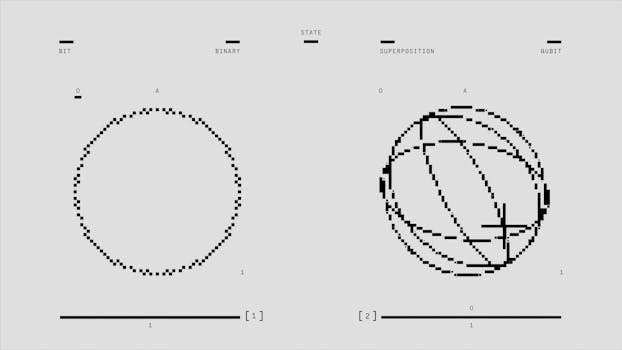
Illustration depicting classical binary bit and quantum qubit states in superposition and binary. Photo: Google DeepMind / Pexels
To truly grasp how quantum computing works, one must first understand its foundational departure from classical computing: the transition from bits to qubits and the mind-bending concept of superposition. In the world of classical computers, information is stored and processed using bits, which are binary digits representing either a 0 or a 1. This deterministic nature forms the backbone of all modern digital technology, from your smartphone to supercomputers. Every piece of data, every instruction, every pixel on your screen is ultimately encoded as a sequence of these definitive 0s and 1s. This approach, while incredibly powerful for a vast range of tasks, encounters fundamental limitations when dealing with problems that scale exponentially in complexity, such as simulating molecular interactions or optimizing vast, interconnected networks. Quantum computing introduces the 'qubit' (quantum bit), which is the quantum analogue of a classical bit. However, the qubit is far more sophisticated. Thanks to the principles of quantum mechanics, a qubit isn't restricted to being just a 0 or a 1. Instead, it can exist in a 'superposition' of both states simultaneously. Imagine a spinning coin: while it's in the air, before it lands, it's neither definitively heads nor tails; it's a probabilistic combination of both. A qubit behaves similarly, existing in a combination of 0 and 1 with a certain probability for each. It's only when we measure the qubit that it 'collapses' into a definite classical state of either 0 or 1. This ability to be in multiple states at once is revolutionary. Consider the implications: with just two classical bits, you can represent one of four possible states (00, 01, 10, 11) at any given time. With two qubits, due to superposition, you can effectively represent all four of these states simultaneously. As you add more qubits, this power scales exponentially. For instance, with 300 qubits, a quantum computer could potentially represent more states than there are atoms in the observable universe. This parallel processing capability is what gives quantum computers their theoretical edge over classical machines for certain types of problems. It allows them to explore a vast landscape of solutions concurrently, rather than sequentially trying each possibility one by one. This fundamental shift in information representation and processing is the first, crucial step in understanding the immense potential and the complex mechanics of how quantum computing works. It's not about being faster at every task, but about being capable of tackling problems that are simply intractable for even the most powerful classical supercomputers. This opens doors to breakthroughs in fields like materials science and drug discovery, where simulating complex molecular structures is paramount. Understanding this basic principle is key to appreciating the future of computation. The delicate nature of superposition also presents significant engineering challenges, as maintaining these quantum states requires extreme isolation from environmental interference, leading to the development of highly specialized hardware.

The Power of Connection: Entanglement and Interference
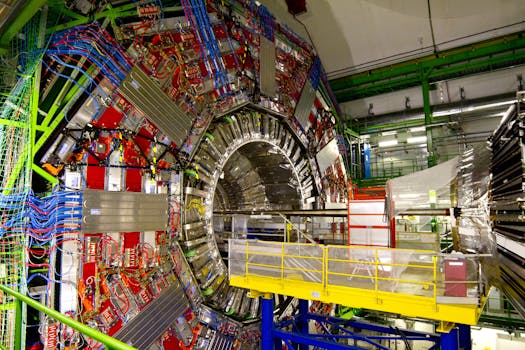
A close-up view inside CERN's Large Hadron Collider in Geneva, Switzerland. Photo: Ramaz Bluashvili / Pexels
Beyond superposition, two other bizarre and incredibly powerful quantum phenomena—entanglement and interference—are central to how quantum computing works. These concepts, once dismissed by Einstein as “spooky action at a distance,” are precisely what allow quantum computers to perform computations that are impossible for classical machines. Entanglement occurs when two or more qubits become inextricably linked, regardless of the physical distance separating them. The state of one entangled qubit instantly influences the state of the others. This means that if you measure one qubit and it collapses into a 0, you immediately know the state of its entangled partner, even if it's light-years away. This instantaneous correlation, without any apparent communication, is what makes entanglement so counter-intuitive and yet so powerful for computation. Imagine a system of entangled qubits as a single, highly correlated computational unit rather than individual, independent units. When these qubits are entangled, their combined state space becomes exponentially larger and richer than if they were merely in superposition individually. This interconnectedness allows quantum algorithms to explore multiple computational paths simultaneously and efficiently. For example, if you have two entangled qubits, instead of having two independent probabilities, you have a single probability distribution describing the joint state of the two qubits. This creates a much more complex and powerful computational resource. Quantum interference, on the other hand, is the phenomenon where the probability amplitudes of different computational paths can either reinforce or cancel each other out. In quantum mechanics, particles don't just have a definite position; they have a probability wave that describes their likelihood of being in various places. When these probability waves interact, they can constructively interfere (amplify each other) or destructively interfere (cancel each other out), much like waves in water. In quantum computing, algorithms are designed to manipulate qubits in such a way that the correct answers to a problem have their probability amplitudes constructively interfere, making them more likely to be measured. Conversely, incorrect answers have their probability amplitudes destructively interfere, making them less likely to be observed. This intelligent use of interference allows quantum algorithms to efficiently search through a vast number of possibilities, amplifying the signal of the correct solution while suppressing the noise of incorrect ones. It's like navigating a complex maze where, instead of trying every path, you can use a property of the maze itself to guide you directly to the exit. Together, superposition, entanglement, and interference form the triumvirate of quantum mechanics that underpins the power of quantum computing. They enable a completely new paradigm of computation, one that can process and analyze information in ways fundamentally different from any classical computer. The challenge lies in precisely controlling these delicate quantum states, maintaining their coherence, and preventing them from decohering due to environmental noise, which is where much of the current research and engineering effort is focused.

Building Blocks and Algorithms: Quantum Gates and Software
Abstract representation of a futuristic digital processor with glowing elements. Photo: Pachon in Motion / Pexels
Understanding how quantum computing works extends beyond the abstract principles of qubits, superposition, and entanglement to the practical mechanisms of how these quantum phenomena are manipulated to perform computations. This is where quantum gates and quantum algorithms come into play, serving as the building blocks for quantum software and the instructions that tell a quantum computer what to do. Just as classical computers use logic gates (like AND, OR, NOT) to process binary information, quantum computers use quantum gates to manipulate qubits. However, quantum gates are far more complex and operate on the probabilistic and interconnected nature of qubits. Quantum gates are essentially unitary transformations that rotate the state of a qubit or a set of qubits on a conceptual sphere called the Bloch sphere. These rotations allow for the precise control of superposition and entanglement. For instance, a Hadamard gate can take a qubit from a definite 0 or 1 state and put it into an equal superposition of both. A CNOT (Controlled-NOT) gate is a fundamental two-qubit gate that can create entanglement; it flips the state of a 'target' qubit only if a 'control' qubit is in a specific state. By chaining together various quantum gates in a specific sequence, quantum circuits are formed, which are the quantum equivalent of classical circuits, designed to perform a particular computation. The design of these gates and their precise implementation are critical engineering challenges, requiring extremely accurate control over individual quantum systems. Once the hardware is capable of executing these gates, the next crucial component is the quantum algorithm. Unlike classical algorithms that are designed to work with classical bits, quantum algorithms are specifically formulated to leverage superposition and entanglement to achieve computational speedups or solve problems intractable for classical computers. Famous examples include Shor's algorithm, which can efficiently factor large numbers (posing a threat to current encryption methods), and Grover's algorithm, which can search an unsorted database significantly faster than any classical algorithm. These algorithms are not simply faster versions of classical algorithms; they represent entirely new ways of thinking about computation, exploiting the unique properties of quantum mechanics to find solutions. Developing quantum algorithms requires a deep understanding of both quantum mechanics and computer science. Researchers are constantly devising new algorithms for a wide range of applications, including optimizing complex systems, simulating quantum chemistry for drug discovery and materials science, and breaking cryptographic codes. The interplay between quantum hardware (the physical qubits and gates) and quantum software (the algorithms and programming languages) is dynamic and evolving. As hardware improves in terms of qubit count and coherence times, more complex and powerful algorithms can be implemented. Conversely, the development of new algorithms drives the demand for more advanced hardware capabilities. This synergistic relationship is pushing the boundaries of what is computationally possible, paving the way for a future where problems currently considered unsolvable may finally find their solutions through the power of quantum computation. The continuous innovation in this space is what makes quantum computing such a captivating field.

Challenges and the Road Ahead: Making Quantum Computing a Reality

A close-up view inside CERN's Large Hadron Collider in Geneva, Switzerland. Photo: Ramaz Bluashvili / Pexels
While the theoretical potential of how quantum computing works is immense, translating these theoretical advantages into practical, reliable, and scalable machines presents a formidable array of challenges. The journey from conceptual breakthrough to widespread application is long and arduous, marked by significant hurdles in engineering, physics, and computer science. One of the primary challenges is 'decoherence.' Qubits are incredibly fragile and highly sensitive to environmental noise, such as stray electromagnetic fields, temperature fluctuations, or even vibrations. This noise can cause a qubit to lose its quantum state (superposition or entanglement) and 'decohere' into a classical state, effectively destroying the computation. Maintaining quantum coherence for long enough to perform complex calculations is a monumental task, often requiring qubits to be isolated in extreme conditions, such as near absolute zero temperatures or in ultra-high vacuums. Another significant hurdle is 'error correction.' Unlike classical bits, which can be easily duplicated and checked for errors, quantum information cannot be copied without disturbing its state (due to the no-cloning theorem). This makes traditional error correction methods impossible. Quantum error correction codes are being developed, but they require a large number of physical qubits to encode a single, error-corrected 'logical qubit.' This means that to build a fault-tolerant quantum computer capable of solving truly complex problems, we might need millions of physical qubits, far exceeding the hundreds or thousands available in today's most advanced prototypes. The sheer scale and complexity of building such a machine are staggering. Scalability is also a major challenge. Current quantum computers typically have a limited number of qubits, and increasing this number while maintaining coherence and connectivity is incredibly difficult. Different qubit technologies (superconducting qubits, trapped ions, photonic qubits, topological qubits) have their own advantages and disadvantages regarding scalability, stability, and connectivity. Researchers are actively exploring which approach will ultimately prove most viable for building large-scale quantum computers. Furthermore, the development of robust and accessible quantum programming languages and software tools is crucial for democratizing access to quantum computing and enabling more researchers and developers to contribute to the field. The current landscape is still nascent, with specialized tools and a steep learning curve. Despite these challenges, the progress in quantum computing has been remarkable. Governments, academic institutions, and tech giants are investing heavily in research and development, leading to rapid advancements in qubit quality, coherence times, and control techniques. The 'noisy intermediate-scale quantum' (NISQ) era, characterized by quantum computers with tens to hundreds of qubits that are not yet error-corrected, is already showing promise for specific applications, though achieving 'quantum supremacy' (where a quantum computer performs a task provably beyond the reach of any classical computer) is just one step. The ultimate goal is to build fault-tolerant quantum computers that can consistently outperform classical machines for a wide range of significant problems. While a universal, fault-tolerant quantum computer is still likely decades away, the incremental progress being made is continuously pushing the boundaries of what's possible, promising a future where quantum computing could revolutionize industries from medicine to finance and artificial intelligence.

Comparison

FeatureQuantum ComputerClassical SupercomputerYour Laptop
Fundamental UnitQubit (0, 1, or superposition)Bit (0 or 1)Bit (0 or 1)
Information StorageSuperposition, EntanglementTransistors, CapacitorsTransistors, Capacitors
Processing ParadigmProbabilistic, ParallelDeterministic, SequentialDeterministic, Sequential
Problem SolvingExponential complexity (specific)Polynomial complexityPolynomial complexity
Temperature RequirementNear Absolute Zero (often)Room Temperature (cooled)Room Temperature (fan)
Error CorrectionExtremely ComplexWell-establishedWell-established
Current AvailabilityResearch & Cloud AccessSpecialized FacilitiesConsumer Market

What Readers Say

"This article brilliantly demystifies how quantum computing works. The explanations of superposition and entanglement were exceptionally clear, making a complex topic accessible. I now feel I have a solid foundational understanding."

Dr. Elena Petrova · Boston, MA

"As a software engineer, I've been curious about quantum computing. This piece provided the 'why' and 'how' in an engaging way. The analogies really helped solidify the concepts without oversimplifying them."

Mark Chen · Seattle, WA

"I always found quantum mechanics intimidating, but this article broke down how quantum computing works into understandable segments. I particularly appreciated the comparison to classical bits; it really clarified the performance difference."

Sarah Davis · Austin, TX

"A very thorough overview of quantum computing's mechanics. While some parts were still quite dense, the overall structure and detailed explanations made it a valuable read for anyone serious about understanding the topic."

James Rodriguez · Chicago, IL

"The insights into quantum gates and algorithms were particularly useful for my research project. This article provides a comprehensive look at how quantum computing works, from the very basics to the cutting-edge challenges."

Anya Sharma · San Francisco, CA

Frequently Asked Questions

What is the main difference between classical and quantum computing?

The main difference lies in how they process information. Classical computers use bits (0 or 1), while quantum computers use qubits, which can be 0, 1, or both simultaneously (superposition). Quantum computers also leverage entanglement and interference, enabling them to solve certain complex problems intractable for classical machines by exploring multiple possibilities in parallel.

Is quantum computing going to replace classical computing?

No, quantum computing is not expected to replace classical computing entirely. Instead, it is seen as a powerful complement. Classical computers excel at a vast range of tasks, and quantum computers are designed for specific, highly complex problems that classical machines cannot efficiently handle. They will likely work in tandem, with quantum computers acting as specialized accelerators for particular computational challenges.

How do quantum computers perform calculations?

Quantum computers perform calculations by manipulating qubits using quantum gates. These gates apply unitary transformations that change the quantum state of qubits, leveraging superposition and entanglement. Quantum algorithms are sequences of these gates designed to enhance the probability of obtaining the correct answer upon measurement, effectively 'programming' the quantum system to solve a problem.

How much does a quantum computer cost?

Currently, quantum computers are extremely expensive, often costing millions of dollars for research-grade systems, and are primarily owned by large tech companies, governments, and research institutions. Access is typically provided via cloud services, where users pay for computational time. As the technology matures, costs may decrease, but they are unlikely to become consumer products in the foreseeable future.

How do quantum computers compare to supercomputers?

Quantum computers are fundamentally different from supercomputers. Supercomputers are very powerful classical machines that perform classical computations at extremely high speeds. Quantum computers, while not necessarily 'faster' in a general sense, can solve entirely different types of problems by leveraging quantum mechanics, making certain exponential problems tractable that even the most powerful supercomputers cannot solve within a reasonable timeframe.

Who should learn about how quantum computing works?

Anyone with an interest in the future of technology, especially those in scientific research, engineering, cryptography, finance, and materials science, should learn about how quantum computing works. Developers, data scientists, and strategists looking to understand future computational capabilities and their implications across various industries will also find this knowledge invaluable.

Are there any risks associated with quantum computing?

Yes, there are potential risks, primarily concerning cryptography. Shor's algorithm, if implemented on a large-scale quantum computer, could break many of the public-key encryption standards (like RSA) that secure our internet communications today. This has led to intense research into 'post-quantum cryptography' to develop new encryption methods resistant to quantum attacks. Other risks are still largely theoretical, but ethical considerations for such powerful technology are ongoing.

What is the future trend for quantum computing development?

The future trend for quantum computing development involves continued progress in increasing qubit count, improving qubit coherence times, and enhancing error correction capabilities to build fault-tolerant quantum computers. We can expect advancements in quantum software, new algorithms, and the emergence of hybrid classical-quantum computing models, gradually moving towards practical applications in specialized domains over the next few decades.

The world of quantum computing is rapidly evolving, promising to reshape industries and solve humanity's greatest challenges. By understanding how quantum computing works, you're not just learning about technology; you're peering into the future of innovation. Continue your exploration and stay informed about this transformative field.

Topics: how does quantum computing workquantum mechanics explainedqubits vs bitsquantum entanglementquantum algorithms
Leo List
Brampton weed
Adultwork EstrelaBet Vai de Bet R7 Bet Betão Galera Bet Rainbet Bet9ja Shop SportyBet BetKing Sisal Loto Foot Hollywoodbets YesPlay Odibets RushBet Jugabet BetWarrior BetCity MSport betPawa Fortebet