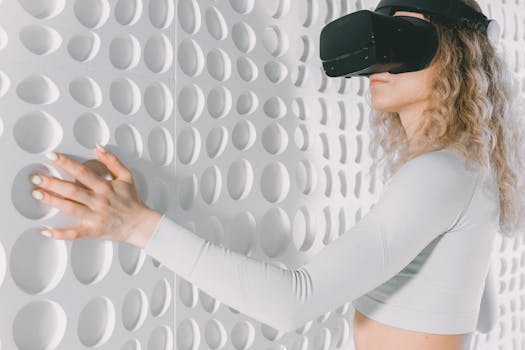
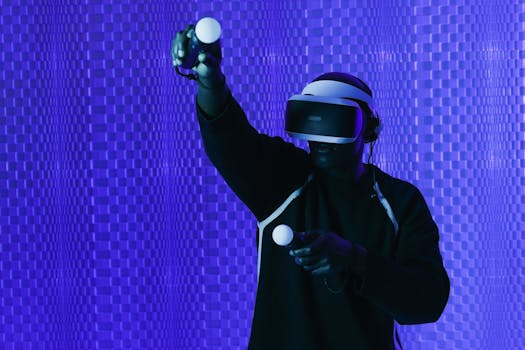
✓ VR gaming market projected to reach over $50 billion by 2030.
✓ Haptic feedback and full-body tracking are becoming standard.
✓ Brain-Computer Interfaces (BCIs) are emerging as a revolutionary control method.
✓ Cloud VR streaming will democratize access to high-fidelity experiences.
How It Works
1
Enhanced Immersion Through Advanced Hardware
Next-gen VR headsets will feature higher resolution displays, wider fields of view, and lighter designs. This reduces motion sickness and increases user comfort for longer play sessions.
2
Revolutionary Input and Feedback Systems
Beyond traditional controllers, haptic suits, gloves, and even full-body tracking will allow players to feel and interact with virtual worlds. This creates an unprecedented level of physical presence and engagement.
3
AI-Powered Dynamic Worlds
Artificial intelligence will drive more responsive and adaptive game environments, non-player characters (NPCs), and storylines. This ensures every playthrough feels unique and personally tailored to the player's actions.
4
Seamless Connectivity and Social Experiences
Improved network infrastructure and cloud computing will enable persistent, massive multiplayer VR worlds. Players can seamlessly connect, collaborate, and compete in shared virtual spaces, fostering vibrant online communities.
The Evolution of Immersive VR Hardware and Displays
The journey into the future of virtual reality gaming begins with the hardware that delivers these experiences. Current VR headsets, while impressive, are merely the stepping stones to what's next. We're on the cusp of a revolution in display technology, optics, and form factor that will fundamentally redefine immersion. Imagine headsets that are as light and comfortable as a pair of sunglasses, yet capable of rendering photorealistic worlds with unparalleled clarity. This isn't science fiction; it's the trajectory of innovation. Future VR displays will boast resolutions far exceeding 8K per eye, pushing past the 'retina' threshold where individual pixels become indistinguishable to the human eye. This eliminates the dreaded 'screen-door effect' and significantly enhances visual fidelity, making virtual environments feel truly present. Beyond sheer pixel count, advancements in micro-LED and OLED technologies will deliver vibrant colors, true blacks, and incredible contrast ratios, bringing virtual worlds to life with breathtaking realism.
Another critical area of development is the field of view (FoV). While current headsets typically offer FoVs between 90-110 degrees, the human eye has a much wider peripheral vision. Future headsets will aim for FoVs closer to 180-200 degrees, encompassing more of our natural sight and further reducing the feeling of looking through binoculars. This expanded peripheral vision is crucial for creating a more convincing sense of presence and reducing motion sickness. Furthermore, variable focal arrays and foveated rendering will become standard. Foveated rendering utilizes eye-tracking technology to render the area where your gaze is focused at maximum resolution, while intelligently reducing the detail in your peripheral vision. This dramatically reduces the computational power required, allowing for higher frame rates and more complex scenes, even on less powerful hardware. Variable focal arrays, on the other hand, address the vergence-accommodation conflict – a common cause of eye strain and discomfort in VR. By dynamically adjusting the focal depth of the display, these systems mimic how our eyes naturally focus on objects at different distances, making virtual objects appear more physically present and reducing visual fatigue. The integration of these technologies will not only make VR gaming more comfortable but also profoundly more believable. The hardware will fade into the background, leaving only the virtual world itself. This will open up new avenues for game design, allowing developers to create experiences that are not just visually stunning but also physically and psychologically engaging. The pursuit of perfect immersion is relentless, and the next generation of VR hardware is poised to deliver a leap forward that will captivate gamers worldwide. The advancements in display and optical technology are not just incremental; they represent a paradigm shift in how we perceive and interact with digital content, promising a future where the line between reality and simulation blurs. Understanding these technological leaps is key to appreciating the coming revolution.
Revolutionizing Interaction: Haptics, Full-Body Tracking, and BCIs
The future of virtual reality gaming isn't just about what you see; it's about what you feel and how you interact. Current VR interactions, while functional, often rely on hand controllers that break the sense of full immersion. The next wave of innovation will focus on making interactions seamless, intuitive, and deeply physical. Haptic feedback is at the forefront of this revolution. Imagine feeling the recoil of a weapon, the texture of a virtual surface, the impact of a punch, or even the gentle touch of a virtual character. Advanced haptic suits, gloves, and even full-body systems are moving beyond simple vibrations to deliver nuanced, localized sensations. These systems use a combination of pneumatic actuators, electro-tactile feedback, and even temperature manipulation to simulate a wide range of physical stimuli. This isn't just about making games more exciting; it's about making them more believable and engaging on a fundamental level. When you can feel the rain on your virtual skin or the resistance of pulling a bowstring, the virtual world ceases to be a mere visual experience and becomes a tangible one.
Beyond haptics, full-body tracking is set to become a standard feature. While some solutions exist today, they often involve cumbersome external sensors or limited tracking points. Future systems will integrate seamlessly into clothing or be entirely camera-based, allowing for unrestricted movement and accurate representation of your entire body within the virtual space. This means your virtual avatar will precisely mirror your physical movements, enabling more natural locomotion, combat, and social interactions. Imagine dodging a virtual projectile with a real-world duck, or performing a complex dance move that your avatar perfectly replicates. This level of fidelity unlocks entirely new gameplay mechanics and social experiences, making virtual worlds feel like true extensions of our physical selves.
However, the most revolutionary leap in interaction lies in Brain-Computer Interfaces (BCIs). While still in early stages of development for consumer gaming, BCIs hold the promise of direct thought control. Imagine navigating menus, casting spells, or even expressing emotions in-game simply by thinking them. Early BCI applications might focus on subtle inputs, like selecting options or performing simple actions, but the long-term potential is immense. This technology could bypass physical controllers entirely, offering an unprecedented level of immersion and accessibility. For players with physical disabilities, BCIs could unlock gaming experiences previously inaccessible. The ethical considerations and technical challenges are significant, but the potential for BCIs to transform how we interact with virtual worlds is undeniable, promising a future where our thoughts directly shape our gaming experience. This convergence of advanced haptics, precise full-body tracking, and nascent BCI technology will redefine what it means to 'play' a game, transforming it into a truly embodied experience.
The Metaverse and AI: Shaping Dynamic Virtual Worlds and Social Play
The future of virtual reality gaming is inextricably linked to the concept of the metaverse and the transformative power of artificial intelligence. The metaverse, often envisioned as a persistent, interconnected network of virtual worlds, is the ultimate destination for VR gaming. It's a place where players can seamlessly transition between different games, social hubs, and creative spaces, carrying their avatars and digital assets with them. This isn't just about playing a single game; it's about living a parallel digital life. Imagine attending a virtual concert with friends, then jumping into a competitive esports match, and later exploring a user-generated world, all within the same overarching metaverse framework. This level of interoperability and persistence will foster unprecedented social connections and economic opportunities within virtual spaces. User-generated content will explode, allowing players to not only consume but also create their own games, experiences, and assets, further enriching the virtual ecosystem. The metaverse represents a shift from isolated gaming experiences to a unified, living digital universe where communities thrive and creativity flourishes.
Artificial intelligence will be the driving force behind the dynamism and responsiveness of these metaverse environments. Current game AI, while advanced, often follows pre-scripted paths. Future AI will be far more sophisticated, capable of generating dynamic storylines, adapting to player choices in real-time, and creating non-player characters (NPCs) with believable personalities and motivations. Imagine an open-world RPG where NPCs remember your past interactions, react to your reputation, and even evolve their own goals and relationships based on the unfolding narrative. This level of procedural generation and adaptive storytelling will ensure that every playthrough is unique and deeply personal. AI will also play a crucial role in world generation, allowing for vast, detailed, and ever-changing environments that feel truly alive. From dynamic weather systems that influence gameplay to ecosystems that respond to player actions, AI will make virtual worlds feel less like static backdrops and more like living, breathing entities.
Furthermore, AI will enhance social interactions within VR. AI-powered companions could offer personalized assistance, guidance, or even emotional support within games. AI will also be instrumental in moderating large virtual spaces, ensuring positive interactions and combating toxicity. The combination of a persistent, interconnected metaverse and intelligent, adaptive AI will create virtual reality gaming experiences that are not just entertaining, but profoundly immersive, social, and endlessly replayable. This synergy will unlock new genres of games, foster vibrant digital economies, and ultimately redefine the very nature of online interaction. The future of VR gaming is not just about better graphics or more realistic sensations; it's about creating entire digital societies powered by intelligent systems, offering unparalleled opportunities for exploration, connection, and self-expression. The ethical implications of such advanced AI in virtual worlds will also need careful consideration as these technologies mature.
Overcoming Challenges and Embracing the Future of Virtual Reality Gaming
While the future of virtual reality gaming shines bright with promise, several significant challenges must be addressed to realize its full potential. The first, and perhaps most critical, is accessibility. Current high-end VR setups remain expensive, creating a barrier to entry for many potential players. Future advancements must focus on reducing hardware costs while simultaneously improving performance. Cloud VR streaming, where games are rendered on powerful remote servers and streamed to lighter, less expensive headsets, offers a promising solution. This model could democratize access, making high-fidelity VR experiences available to anyone with a stable internet connection, much like how streaming services transformed video consumption.
Another persistent challenge is motion sickness, or 'sim-sickness.' While improvements in display technology, higher refresh rates, and foveated rendering are helping, game design plays a crucial role. Developers must continue to innovate with locomotion schemes that minimize discomfort, such as teleportation, smooth movement with comfort options, and even integrating haptic feedback to ground the player's perception. Education and best practices for users, such as taking breaks and gradually building tolerance, will also be vital.
**Key Challenges and Solutions:**
* **Cost of Entry:** Cloud VR streaming, modular hardware, and increased competition will drive prices down, making VR more affordable.
* **Motion Sickness:** Higher refresh rates, foveated rendering, improved game design with comfort options, and user education are key.
* **Content Library:** As the user base grows, so too will the incentive for developers to create a wider variety of high-quality, long-form VR titles.
* **Physical Space Requirements:** Room-scale VR will be complemented by inside-out tracking and mixed reality overlays, allowing for more flexible play spaces.
* **Social Integration:** Seamless cross-platform play, robust avatar customization, and intuitive social features within metaverse platforms will enhance community.
Privacy and data security will also become paramount as VR systems collect more personal data, from eye-tracking information to biometric responses. Robust ethical frameworks and transparent data handling policies will be essential to build user trust. Finally, the content pipeline needs to mature. While there are many excellent VR games, the breadth and depth of experiences need to expand to attract and retain a mass audience. As the user base grows and technology becomes more standardized, we can expect a surge in AAA VR titles and innovative indie experiences. The journey to the ultimate future of virtual reality gaming is not without its hurdles, but the industry is actively working to overcome them, paving the way for a truly transformative era of interactive entertainment.
Comparison
Feature
Future VR (2030+)
Current High-End VR (2023)
Early VR (2016)
Display Resolution (per eye)
12K+
2K-4K
1K-2K
Field of View
180-200 degrees
90-110 degrees
90 degrees
Input/Feedback
BCI, Full Haptics, Full-Body Tracking
Hand Controllers, Basic Haptics
Hand Controllers
Form Factor
Lightweight Glasses/Goggles
Bulky Headset
Very Bulky Headset
Processing Power
Cloud/Edge Computing
On-device/PC tethered
PC tethered
Motion Sickness
Minimal
Reduced with comfort options
Common
Social Interactivity
Persistent Metaverse, AI NPCs
Multiplayer Lobbies
Limited Multiplayer
Price (Consumer)
$300-600
$600-1500
$400-800 (plus PC)
What Readers Say
★★★★★
"The potential of future VR gaming is mind-blowing. I can't wait for the day I can truly feel the virtual world around me, not just see it. It's going to redefine entertainment completely."
Alex Chen · Seattle, WA
★★★★★
"I'm already hooked on current VR, but reading about BCIs and full-body haptics makes me so excited. Imagine playing an RPG where your thoughts control magic – that's next-level immersion!"
Maria Rodriguez · Austin, TX
★★★★★
"As a game developer, the advancements in AI and metaverse concepts for VR are inspiring. It means we can build truly dynamic, living worlds that respond to players in unprecedented ways, leading to endless replayability."
David Lee · Orlando, FL
★★★★★
"While the future sounds incredible, I hope the industry focuses on making it affordable and accessible for everyone. Cloud VR sounds like a great step in that direction, as current costs are a barrier."
Sarah Miller · Denver, CO
★★★★★
"I'm most excited about the social aspects of future VR. A persistent metaverse where I can hang out with friends, play different games, and even create content together sounds like the ultimate online experience."
Omar Hassan · Chicago, IL
Frequently Asked Questions
What is the most significant technological leap expected in the future of virtual reality gaming?
The most significant leap is anticipated in the convergence of advanced haptic feedback systems, full-body tracking, and nascent Brain-Computer Interfaces (BCIs). These technologies promise to move beyond visual and auditory immersion to provide tactile sensations and direct thought control, making virtual worlds feel physically real and interactive.
Will future VR gaming still cause motion sickness?
While motion sickness is a common concern with current VR, future advancements are actively addressing it. Higher resolution displays, wider fields of view, variable focal arrays, and foveated rendering will reduce visual discrepancies. Additionally, improved game design with diverse locomotion options and better haptic feedback will help ground players, significantly minimizing discomfort.
How will Brain-Computer Interfaces (BCIs) change VR gaming?
BCIs could revolutionize VR gaming by allowing direct thought control, bypassing traditional controllers. This could enable players to navigate menus, cast spells, or even express emotions simply by thinking. While still in early stages, BCIs promise unparalleled immersion and accessibility, especially for players with physical disabilities, by making mental commands actionable within the virtual world.
Will future VR gaming be affordable for the average consumer?
Affordability is a major focus for the future of VR gaming. While initial high-end hardware may remain premium, the rise of cloud VR streaming services is expected to democratize access. This model allows games to be rendered on powerful remote servers and streamed to lighter, less expensive headsets, making high-fidelity VR experiences accessible to a much broader audience with a stable internet connection.
How will the future of virtual reality gaming compare to traditional console gaming?
The future of virtual reality gaming aims to offer a fundamentally different and more immersive experience than traditional console gaming. While consoles provide engaging flat-screen experiences, VR strives for full sensory immersion, making players feel physically present within the game world. With advancements in haptics, full-body tracking, and BCIs, VR will offer a level of interaction and presence that traditional gaming cannot match, blurring the lines between reality and simulation.
Who should be most excited about the future of virtual reality gaming?
Anyone seeking a deeper, more immersive, and interactive form of entertainment should be excited. This includes hardcore gamers looking for next-level experiences, social gamers eager for persistent metaverse interactions, creative individuals interested in user-generated content, and even those with physical disabilities who may find new avenues for gaming through advanced accessibility features like BCIs.
Are there any ethical concerns regarding the future of virtual reality gaming?
Yes, ethical concerns primarily revolve around data privacy and security, especially as VR systems collect more personal data like eye-tracking and biometric information. There are also considerations regarding potential addiction, the psychological impact of highly realistic virtual worlds, and the need for responsible AI development to ensure fair and unbiased virtual environments. Transparent data policies and robust ethical frameworks will be crucial.
What role will AI play in the future of VR gaming beyond graphics?
Beyond graphics, AI will be pivotal in creating dynamic, responsive virtual worlds and intelligent non-player characters (NPCs). AI will drive adaptive storylines, generate vast and detailed environments, and enable NPCs with believable personalities and motivations that react to player choices. This will ensure every playthrough feels unique, personal, and profoundly engaging, making virtual worlds feel truly alive and responsive.
The future of virtual reality gaming is not just an evolution; it's a revolution in how we play, connect, and experience digital worlds. As hardware becomes more seamless, interactions more intuitive, and virtual environments more intelligent, we stand on the precipice of an era where gaming transcends entertainment to become an integral part of our lives. Don't just observe the future – prepare to step into it.